 |
| A Black H'mong Village on the Outskirts of Sapa |
(Continued from Part 1) The harsh beep of the hotel's bedside alarm clock wakes me from a restful sleep, or at least much more so than the prior night's decidedly unsound sleep on the Livitrans night train from Hanoi. My room is pleasantly cool, as I had opted to leave the door to the balcony slightly open during the night, having discovered earlier when I arrived that the room only had a heater (no surprise given the hotel's mountainside location) and was a bit too warm and cozy for my tastes. I figured given the altitude and ambient temperature, there was little likelihood that I would wake up with a room full of mosquitoes, despite the rice terraces lining the hillsides that lead down into the valley. It must have rained, as I can hear the rhythmic patter of water droplets falling on the damp floor of the balcony outside, the distant sound of voices in conversation (perhaps passing greetings uttered in Vietnamese or H'mong?) and at one point the sputter of a slowly passing motor scooter throttled just barely above idle.


I roll out of bed and walk over to the balcony doors to take in the morning view before heading down (or rather up, given the layout of the hotel) to breakfast buffet. The sky is cloudy and gray with a light drizzle falling and a thin fog beginning to drift up from the valley. I take a few photos to capture some of the panoramic view that my balcony provides (which includes the rows of neighboring balconies and rooftops of the other hotels that share this stretch of south Sapa ridge-line, with the construction of a new hotel going on nearby), though the view of cascading hills and distant conical peaks directly ahead is becoming more obscured and less photogenic by the moment as the fog continues its advance. A few floors below me a paved one-lane road leads down the ridge, upon which a couple of of local women wearing the woven conical 'non la' hats are making their way uphill, one of them with what looks to be some type of leafy produce in a woven baskets strapped to her back.
I grab my small day back, some bottled water and my two cameras (the formerly-trusty Casio Exilim now relegated to shooting only video after a few days of use in Singapore) and head to the hotel's dining room for breakfast. The offering on the buffet table are of the standard variety for hotels in Southeast Asia that cater to the tastes of both locals and Western tourists. I opt for some scrambled eggs, bacon, a croissant and some sliced dragon fruit, pair with some black Vietnamese coffee, which is thankfully darkly-roast and pleasantly strong with a semi-sweet, somewhat earthy flavor profile that the coffee grown in Southeast Asia seems to have when not altered by the addition of sugar and cream or condensed milk. I polish off my third refill of coffee and make my way to the lobby, as my guide is due to meet me there in about five minutes. As I approach the front desk, I am surprised to see a small perhaps Pomeranian mix-type dog with close-cropped, tan-colored fur over most of the body, but the fur on the muzzle, around the eyes and the back of the haunches left standard-issue Pomeranian white, and the fur around the head and upper neck, the base of the paws and the tip of the tail dyed a sort of rose color. The intended effect of the owner, to make the dog resemble a miniature male lion, was readily apparent and prompted a surprised look from me followed by a chuckle. The girl behind the counter seemed pleased by my reaction, and when I commented how cute the dog looked, the girl responded, "Is not dog. Is lion...", with a playful smile. I leave my room key at the front desk and walk to the lobby entrance in anticipation of my guide and driver arriving at any moment.The fog is settling in as my guide enters the lobby and bids me a good morning, telling me that our drive is park ahead at the intersection of P Cau May Street. As we walk up to the car he tells me that the original plan was to have a picnic upon reaching the final destination of the trek, which would be the Red D'zao hill-tribe village of Ta Phin, but that we may have to alter the plan if the weather doesn't improve by late morning.


We drive about 8 km due northeast of Sapa, then exit the car and being hiking along a rock-strewn dirt road; it leads through a stretch of trees and tall brush to a ridge-line that overlooks a valley veiled in a haze of light fog. Even with the limited visibility, the numerous stair-stepped rice terraces on the nearby slopes are still a sight to behold. As the road follows its sinuous course down into the valley, more expansive views of the terraces are opening up before us. We also begin encountering Black H'mong hill-tribe villages on the trail. My guide greets them as we pass and sometimes stops to briefly chat with them in their native H'mong language, and when the villagers have a child with them, he will take a small treat or snack out of his pack to give them.


 |
| Morning Views from My Hotel Balcony |
 |
| The Chau Long Sapa Hotel 'Lion Dog' |
 |
| A Foggy Start to My Morning Trek |


 |
| First Rice Terrace Views and Hill-tribe Encounters on the Trail |
We drive about 8 km due northeast of Sapa, then exit the car and being hiking along a rock-strewn dirt road; it leads through a stretch of trees and tall brush to a ridge-line that overlooks a valley veiled in a haze of light fog. Even with the limited visibility, the numerous stair-stepped rice terraces on the nearby slopes are still a sight to behold. As the road follows its sinuous course down into the valley, more expansive views of the terraces are opening up before us. We also begin encountering Black H'mong hill-tribe villages on the trail. My guide greets them as we pass and sometimes stops to briefly chat with them in their native H'mong language, and when the villagers have a child with them, he will take a small treat or snack out of his pack to give them.


 |
| Black H'mong Woman with Child Transplanting Rice Seedlings |
A bit further down the trail, we approach the first section of rice terraces that are being actively worked by a group of Black H'mongs. Down in the paddies, the Black H'mong women, many wearing traditional black hemp jackets and Vietnamese style ‘non la’ conical straw hats, appear to be performing the bulk of the work. One of the women has a baby secured to her back with a wrapped blanket harness as she leans down to transplant a seedling in the paddy’s soft mud bottom. A young girl nearby uses the same technique to carry her baby sibling as she carefully walks along a muddy trail that runs between the terraced paddies; I later take a photo of her as she watches her mother from behind barbed wire fencing. Other children play nearby amid grazing water buffalo while their family members work in the paddies; their young voices and laughter mix with the sounds of water gurgling down the rungs of the terraces, the sloshing of ankles treading through brown water and the murmur of conversations from the paddies, the calls of birds and croaking frogs, and the dull hollow clanking of buffalo bells.


 |
| The Interior of a Black H'mong House in Ma Tra Village |
After cresting a small hill the trail takes us into the Black H’mong village of Ma Tra, where my guide says we will spend some time touring a tradition village home; he adds that he has brought some small cakes to offer to the children of the family, and that I am welcome to also offer something to the family. We stop amid a small group of wood and corrugated tin roof houses, and enter one of them located adjacent to and perhaps a few feet below the right-hand side of the trail after my guide announces our presence. The rustic interior is illuminated by the natural light coming through two open doorways, a small window, and the open spaces that provide for ventilation between the walls and framing of the house and the corrugated roof; the gaps between the wall’s vertical wood planks also cast some addition light into the home and contribute on a micro scale to ventilating the lingering scent of wood and tobacco smoke. The rough concrete floor of the house features a fire pit encircled by flat rocks, with a section of steel re-bar bent into an elongated ‘U’ supporting a soot-blackened kettle; an old treadle-operated sewing machine and a manual weaving loom sit in the corner of the main room of the house near one of the doors to take advantage of the natural light.
 |
| The 92-Year Old Matriarch |


 |
| The Household Meat Storage Area |
Two elderly Black H’mong women are present in the home, the eldest being the 92-year old matriarch of the family; the somewhat younger of the two is sitting by the fire pit and smoking locally-grown tobacco from an old black bamboo pipe. My guide takes a seat on a small wooden stool by her and introduces me to the women and the children of the extended family. The ten young children that are currently in the home, ranging in age from toddler to perhaps seven years, at first congregate atop or in front of an old wooden pedestal bed, beneath which lay an assortment of rubber boot in various sizes, colors and amounts of residual mud; after some initial apprehension, their curiosity sets in and they start mingling with me. My guide next offers me a sample of the local tobacco from the younger auntie’s pipe. Sitting across the fire pit from auntie, I hold the pipe’s opening to my lips and inhale; the harshness of the smoke causes me to cough vigorously, which of course causes everyone else to laugh hardily. My guide distributes the sweets to the village kids, and then walks me around to point out the various features of the house. Perhaps the most interesting feature is the family meat storage area, where portions of an animal carcass are hung from the ceiling.


After the brief tour of the home, I thank the aunties for their hospitality and give them each some Vietnamese Dong as a gift to the family before we take our leave. Some of the kids follow us outside, and given that the interior of the rustic home was a bit too dim to allow me to shoot any video, I decide to take a video clip of the village kids that have now assembled on the trail in front of the home to see us off. As I begin shooting, the youngest kid (a toddler of maybe two years of age?) joins the group, and in panning up to the others kids, a couple seem a bit shy about being videoed as they assume mock defensive postures before comically mimicking my glasses by forming circles with their thumbs and index fingers and holding them to their eyes. My guide begins speaking to them in their native H'mong language (a H'mong girl working one of the fruit and vegetable stalls with her mother and brother at one of the local farmers' market back in the States would later tell me that all H'mong tribes - Black, Green, Flower, etc. - generally all speak the same dialect, and that it is only their particular style and colors of dress that divides them into sub-groups); though the eldest kid at first indicates by his tone of voice, expression and body language that he's having no part of being videoed or photographed, a bit of conversation with my guide soon lightens his mood. Photos and video footage of the village kids now 'in the bag', we continue on our way. The trail gradual works its way uphill and veers to the right, giving us an overview of the village we've just visited and the cascading terraces below it, other small groups of rustic houses flanked by bamboo fencing, grazing water buffalo and myriad rice terraces flanked by wooded hills veiled in fog as we journey on to the Red D'zao hill-tribe village of Ta Phin.


We approach a terrace of transplanted seedling that’s being worked just off the trail. The nursery paddy at the top of the terrace is occupied by at least a dozen Black H'mong villagers in the process of uprooting seedlings and bundling them for transplantation, and at a distance we can hear the murmur of their conversations punctuated by an occasional feminine laughter and giggling. Below it are several flooded paddies with bundles of seedlings laid out for planting. My guide calls out to the villagers to get their attention, then tells me that we will go down to the terrace for a closure look, and that I can even try my hand at working in the paddy if I want to. I step down onto the second rung of the terrace and take some video of the scenery and the activity in the paddies. I confirm with my guide that I can briefly try my hand at working a rice paddy; he tells me that I can either try uprooting the rice seedlings for transplantation from the nursery paddy, or try re-planting the seedling into a flooded paddy, and that I don’t have to worry about leeches in this part of Vietnam. As the nursery paddy has more villagers working in it, and it appears to be quite lively given the fair amount of chatter and laughter going on between the younger Black H’mongs, I opt for uprooting seedlings; my guide holds my cameras while I’m in the paddy, and tells me that he will also take some photos and videos to document the experience for me.


We approach a terrace of transplanted seedling that’s being worked just off the trail. The nursery paddy at the top of the terrace is occupied by at least a dozen Black H'mong villagers in the process of uprooting seedlings and bundling them for transplantation, and at a distance we can hear the murmur of their conversations punctuated by an occasional feminine laughter and giggling. Below it are several flooded paddies with bundles of seedlings laid out for planting. My guide calls out to the villagers to get their attention, then tells me that we will go down to the terrace for a closure look, and that I can even try my hand at working in the paddy if I want to. I step down onto the second rung of the terrace and take some video of the scenery and the activity in the paddies. I confirm with my guide that I can briefly try my hand at working a rice paddy; he tells me that I can either try uprooting the rice seedlings for transplantation from the nursery paddy, or try re-planting the seedling into a flooded paddy, and that I don’t have to worry about leeches in this part of Vietnam. As the nursery paddy has more villagers working in it, and it appears to be quite lively given the fair amount of chatter and laughter going on between the younger Black H’mongs, I opt for uprooting seedlings; my guide holds my cameras while I’m in the paddy, and tells me that he will also take some photos and videos to document the experience for me.


After removing my shoes, socks and zipper-attached removable long pant legs, I carefully step into the ankle-deep, cappuccino-brown water and feel the warm, slimy mud slowly extrude up between my toes as my bare feet settle to the soft bottom of the paddy. Even though there is no benefit in doing so, I look down at the surface of the opaque water as I take my first tentative steps, which causes the large black water striders around my ankles to quickly dart away. At the sound of laughter, and at least one feminine squeal of delight, I glance up to see the smiling and bemused faces of the villagers who have been pulling up seedling stalks at the far end of the paddy; I manage to make it across to them without doing a face-plant into the muddy water. My mentor, a smiling and patient Black H’mong woman, shows me the proper uprooting technique (right hand palm-up, thumb and index finger at the base of the stalk pressed slightly into the mud, light squeeze, s-l-o-w-l-y pull up), then bundles my seedlings and ties them together with a long grass-like rice leaf.
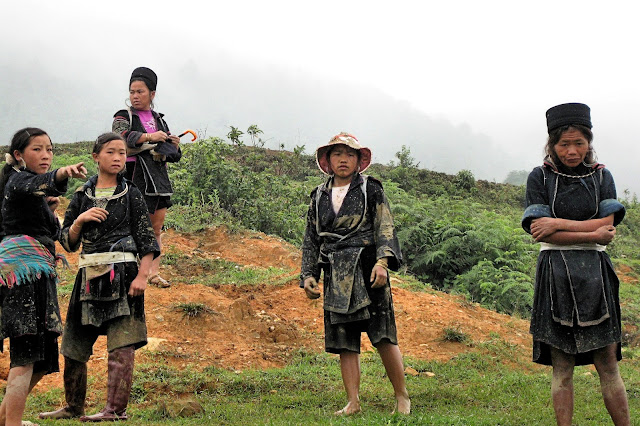
As I uproot my first seedlings, a bit of paddy field horse play breaks out between a Black H’mong girl and two boys that seem to be in their late teens or early twenties in the form of a friendly flicking of mud and water at each other while holding onto bundles of harvested rice seedlings in their left hands. At one point, the girl gets between me and my mentor after reaching down into the brown water and extracting a sticky handful of mud, and when she throws it towards her assailant as he retreats behind me, I feel cool, gritty droplets land on my exposed arm and upon glancing down to see newly-acquired specks of muddy water on my shirt. I’m hoping that my guide captures some of the fray on video. As the paddy fray escalates (and the level of laughter among those working the terrace increases), the rice seedling stalks themselves become ammunition as the muddied H'mong maiden advances on her equally-soiled foe, forcing him to retreat towards the end of the paddy until his counter-mudslinging sends her back squealing in my direction, evoking from him a hardy laugh. I'm hoping that my guide is capturing the action on camera, and as I glance back to the upper terrace I am thankful to see him with my video-dedicated Casio in hand and executing a slow pan. The fight then quickly deescalates to some friendly hand-to-hand mud grappling as the villagers get back to business, and my mentor appears to be pleased with my newly-acquired rice seedling uprooting skills.




 |
| The Mud-Splattered H'mong Maiden |

After my brief stint in the paddy, I follow the lead of a Black H’mong girl and head over to wash my feet and legs in a small brown water brook that sources some terraces below. "You wash?", my guide asks with the recording Casio still in hand. "Oh, yeah...", I respond, which causes the bathing girl to look up in surprise and then smile sweetly as she vacates the small flat spot in the brook's bed where she's been standing for me to use. In later reviewing the photos and video clips that my guide took, I see that he has done an excellent job of documenting my hands-on rice terrace experience, capturing not only the friendly mud and water fight in the paddy and the mud-splattered H'mong maiden, but also an attractive village girl that captured his fancy.




 |
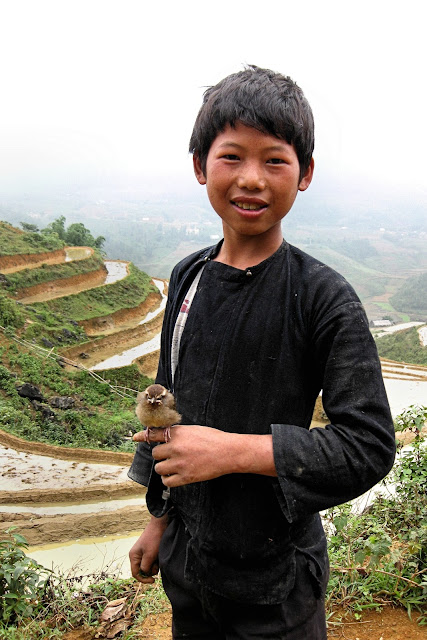
| Hemp for Fabric Weaving, and Nothing Else... |
After putting back on my pant legs, socks and shoes, and shooting some photos and video clips of the Black H'mong hill-tribe villagers that I've just shared a rice paddy with, we are again on our way up the trail to the Red D’zao hill tribe village of Ta Phin. As we continue to gain altitude, we are treated to farther reaching views of the colorful rice terraces when the weather cooperates. The colors of the paddies seen on the slopes below the trail and those in the distance that line the valley's near and far slopes vary with stages of the rice cultivation cycle; those with well-established maturing stalks or seedlings that are grown for transplantation appear as lush curving bands of forest or yellow green; the fallow or bare earth paddies convey the hillside contours in stripes of dull brown and reddish earth tones; paddies that have been flooded and are awaiting transplantation of seedlings present like stacked curved ribbons of dull white fringed in brown as the overcast skies above are reflected between the tops of the earthen levees; those that have been planted with the evenly-spaced seedlings appear light green or pastel gray-green in color. In addition to being visually stunning, the hillsides of rice terraces are all the more amazing given that they had been built by hand with the help of plows pulled by water buffalo. We again encounter more villagers along trail, and and my guide stops and chats with them I head off to frame more photos and slow-panning additional video clips. I notice that the battery life on my small digital camera that is dedicated to shooting video (the still photo capability having earlier ‘gone south’ back in Singapore) is a bit less than half, so I decide to save the power for my planned self-guided trek to the nearby Black H’mong village of Cat Cat after we have lunch and return to Sapa. Along the crests of the hills, the slopes just above the tops of the terraces are cultivated with rows of corn and indigo and dotted with hemp plants; these crops can thrive solely on the precipitation and thus don’t require terracing and irrigation. We begin seeing pine trees along our path, which is something that most do not normally associate with Vietnam or Southeast Asia in general for that matter.


At this point in the trek, we leave the dirt road and occasional passing motorcycles behind and divert onto a narrow dirt trail that meanders up a hillside; the land is lush with crop fields, ferns and scattered pine trees, and the prominent rocky outcroppings backed by mist-veiled mountain ridge lines adds to the picturesque quality of the surroundings. We hike along a stretch of grassy clearing that’s flanked by pine trees and striped with a narrow red dirt track down the center that was likely a road during the French occupation. Passing an old dilapidated house, we stop at the atmospheric ruins of an old French monastery just outside of the village of Ta Phin. We are running behind schedule, and by the time we enter the village it is quite, with the resident Red D’zao villagers resting after their morning’s work out in the field. My guide suggests that we head back to Sapa rather than intrude upon the villagers. We locate our driver and get on the road. Video clips of the trek appear below.
My guide and I are dropped off in front of a restaurant at the corner of P Cau May and D Dong Loi, just up the street from my hotel. We step inside and take a booth, after which my guide produces a plastic grocery bag from his knap sack and places it on the table. As he removes the contents of the bag (a fresh baguette of French bread, a pull-top can of tuna, some sliced tomatoes and cucumbers), he tells me that we were supposed to have a picnic lunch out on the trail, but because of weather and timing the plan had changed, and that the restaurant would allow me to eat my outside lunch seated in the booth. He adds that this is the end of the day’s scheduled activities until 5 PM, when I would be picked up at the hotel and driven back to Lao Cai to board the night train back to Hanoi. I shake his hand and thank him for the morning’s guided trek; as he takes his leave, I order a Lao Cai Beer and make my tuna sandwich.
As I eat, I consider my available time before leaving Sapa and devise a viable schedule; I figure that if I can limit a roundtrip trek to Cat Cat to about two and a half hours, I will have some time to relax and see a bit more of the town before meeting up with my guide and driver. I finish my meal and turn to leave, only to see a lot of people crowded along the sidewalk and curb out front and hear the sound of beating drums and crashing cymbals coming from up the street. It is apparently the funeral procession associated with the gathering that was being held last night next to the Sapa Church.
The procession is lead by men and women carrying large flags and colorful banners with the image of the Buddha on long staffs; they are followed by a van from which someone is tossing out some type of small packets from the window to the crowd at periodic intervals. Next are women in black pants and long black gowns wearing peaked non la conical hats (some are also wearing loops of Buddhist prayer beads around their necks) carrying multicolor banners on staffs, with many of them forming a line and holding a long bolt of yellow cloth with black borders at shoulder level like a dragon in a Chinese New Year parade; the far end of the cloth is attached to a wheeled shrine cart, and some of the women holding the cloth also toss out flyers with big concentric red and yellow rectangles printed on them. Two men carry a large red drum suspended from a yoke carried across their shoulders as another man strikes a gong that he carries; men in naval-looking uniforms and caps play a small drum and traditional ken bau wind instruments that can’t be heard over the din of the large drum and cymbal strikes. Finally, the ornately-decorated funeral cart bearing the deceased passes, pushed by uniformed pall bearers and those close to the deceased, followed by the somber family members in white hooded robes, with others in the crowd of followers wearing white headbands. The procession pauses briefly near the end of P Cau May before continuing on, and as activity along Sapa's main drag begins to transition back to normality I make my way up the street to the starting point of the self-guided trek to Cat Cat village.
About halfway there, I catch a glimpse of Ha, the quirky yet endearing Black H'mong wandering vendor girl that I had the memorable street encounter with last night, wearing the same Chinese-styled embroidered pastel plum blouse, white pleated skirt and belted sash, and the same ornate sling bag of hill-tribe fabrics and garments for sale slung over her shoulder, heading down the sidewalk in my direction. As the distance between us closes, she briefly stops to talk with some visiting tourist, presumably to give them a quick sales pitch, and then moves on in search of the next prospective customer. As our paths meet, we pause and greet each other, and as I'm pleased to have run into her again before leaving Sapa, I try to engage her in a bit more friendly chit-chat, but she seems to be decidedly more impatient that she was last night when I had been considered a potential sale, and as such could not afford the time for any of my "Blah-blah-blah..." (as she had previously described it). She cuts me off with a, "Uh, I can't talk now. I have to go to school soon..." I'm wondering if she attends some informal schooling or training, or if this is just a ruse akin to her 'not having had any dinner last night' to send me on my way and get back to business; as we stand there together ever so briefly, her eyes scan the passing tourists to assess potential sales opportunities, so I figure her statement likely falls into the 'ruse' category. Playing along, I ask her what kind of schooling or training she is doing, and I no sooner finish my question when she suddenly directs her attention across and slightly up the street and points to what looks to be two middle-aged Western tourists walking together. "Oh, there's my friends over there. I've got to go talk to them." I again wish her farewell and good luck, and as she turns to catch up with her 'friends' I get back on my way.
 |
| Ha, the Black H'mong Wandering Vendor Girl |


I take the steps that lead down from P Cau May through the Sapa market and onto D Tue Tinh Street, and then continue downhill onto D Phan Si Street, which quickly takes on the feeling of a country road. As I walk, the breaks in the trees along the left side of the road reveal views of rice terraces and crop field in the fog-shrouded valley below. I shortly come to the ‘Cat Cat Tourism Area’ ticket station, where a 30,000 Dong village admission fee is paid, and a ticket is given that must be later presented at the ticket checking station at the entrance to the village. I continue on the often-steep and winding 1.3km decent into the valley along well-worn tarmac towards the village, passing rural homes, a couple of roadside vendor stalls, and Black H’mong villagers both on foot and on motorcycles along the way.
Given the 2-1/2 hours of trekking this morning and the fatigue that I’m already beginning to feel even on the early downhill portion of this hike, I figure that I’ll be pretty tired by the time I make it back up to the hotel. As I’m thinking this, I hear the sputtering purr and rattle of an approaching motorcycle slowing to a stop next to me. It is one of the ‘xe om’ motorcycle taxis that cruises the route to Cat Cat village in hopes that tourists may suddenly find themselves too tired to walk any further and wish to make use of their services. His says that his name is Star, and proudly points to his namesake painted on his helmet. He asks if I’m heading to Cat Cat, then offers to drive me there and then take me back to Sapa, quoting “...whatever you think it's worth” as the going rate. I pass on the offer, figuring that trekking was one of the reasons I decided to make the trip from Hanoi, and continue on.


I stop at the ticket checking station on the left side of the road to verify payment of the admission fee, then proceeds downhill to the village along the flagstone-paved stairs and walkways that affords good views of rice terraces and chance encounters with the resident Black H'mongs.


The village is quite scenic, with picturesque rice terrace flanked by steep wooded slopes, but it feels too touristy when compared to the morning’s visit to the village of Ma Tra. The village may have started out as traditional, but it had since been developed with the tourist in mind, with a museum house, souvenir stalls and a cultural performance venue. I follow the stairway down to the photogenic Tien Sa waterfall to the sounds of traditional Vietnamese music playing on overhead loud speakers, which is pleasant enough but adds to the subtle ‘theme park’ vibe of the village. A visit to Cat Cat village would definitely be a viable option for the visitor who has only limited time in Sapa, but still wants to do some trekking and sample a bit of the Black H’mong culture. I glance at my watch and decide that I will have to pass on Cat Cat’s other attractions further down the trail, and high-tail it back to the hotel; given the altitude and all though steps leading back up to the village from the waterfall, I’m soon out of breath and realizing that high-tailing it is easier said than done. A passing cool breeze and a light sprinkle of rain helps to reinvigorate me for the trek back into town.
 |
| The Official Entrance to the Black H'mong Village of Cat Cat |


 |
| Tien Sa Waterfall, Below Cat Cat Village |
Sore and exhausted, I’m back on P Cau May Street with time to spare; I had already checked out of the hotel before the trek to Cat Cat and just need to retrieve my pack from the front desk when my guide and driver show up. I stop at a nearby convenience store and pick up some small packs of Oreo cookies for the train ride back to Hanoi and stash them in my small day pack, then walk back up near the Sapa Church and town square to kill some time. There's a small ethnic minorities hill-tribes museum located across the street from the uphill side of the town square, though it is going through a change of exhibits and there is not much there beyond some photos of the different hill-tribes, some maps and charts showing the regional distributions and some thumbnail demographics on them, and some of their traditional household and farming implements. My visit to the museum is thus brief and a bit of a disappointment, so I decide to stroll back to the hotel.
Along the way, I see one of the familiar faces among the traditionally-attired Black H'mong wandering vendor girls along P Cau May Street. I don't know her name, but she had approached my before to sell me some tribal handicrafts and had been friendly and pleasant to speak with, and I had also seen her briefly hang out and chat with Ha. As I walk over to say a quick 'hi and bye' on the way back to the hotel, the girl is speaking with a Western female tourist. In the bit of their conversation that I overhear as I walk up, the woman is asking her if she doesn't want to do more with her life than just sell hill-tribe handcrafts to visiting tourists. They stop their conversation and turned to look at me as I walk up, with the H'mong vendor girl giving a smile of recognition. I apologize for interrupting them, and told the girl that I would soon be leaving Sapa, and that because we had become somewhat familiar with one another during my brief stay in town, I thought I'd stop by and say good bye and good luck. I inquire if she had seen Ha around, mentioning that I had run into her earlier prior to my visit to Cat Cat village and she had mentioned that she was heading off to school, and I was wondering if she was now through with class and back selling her handicrafts among the visiting tourists. The girl gave me a quizzical look and commented that Ha doesn't have school to attend, thereby confirming my initial suspicion. She then extends her hand and says, "Nice to meet you." As I respond in kind, I add, "Oh, just a second..." as I reach into my day pack to extract one of the Oreo packets and open it, then extend the packet in her direction. "Would you like some cookies to snack on?" She pauses for an instant to consider my offer. "No," she responds, "...but if you offer me the whole pack, I'll say thank you..." I pass her the package and she honors her end of the deal with a smile.
It’s nearly 5 PM so I return to the hotel. Just about the time that I'm ready to turn right onto the narrow side street at the bottom of the hill where P Cau May Street hooks to the left for the last time, I smile when I see Ha’s familiar Chinese-styled embroidered ensemble up ahead. I walk over to her and with a knowing grin ask her how 'school' was. With a similar grin, she says that she didn't end up going, and then for a final time brings up that issue about me paying too little for the H’mong mouth harp (the 60,000 Dong asking price verses the 30,000 that I paid), and that the way she sees it, I still owe her something. I reach in my nap sack to extract one of the packs of cookies that I’ve bought for the return trip to Hanoi and hand it to her. "Just a little token for you before I leave Sapa...", I say to her. She takes it, and with a little smile reaches into her ethnic sling bag and produces two cloth tie-on bracelets embroidered with traditional H’mong design elements; she hands them to me, saying that they are a gift. I advise her to stick with her schooling ('wink-wink, nudge-nudge'), and then wish her good luck and good bye before walking over to the hotel, where my guide and driver are now waiting out front. Video clips of Sapa, including the funeral procession and Cat Cat village appear below.
Along the way, I see one of the familiar faces among the traditionally-attired Black H'mong wandering vendor girls along P Cau May Street. I don't know her name, but she had approached my before to sell me some tribal handicrafts and had been friendly and pleasant to speak with, and I had also seen her briefly hang out and chat with Ha. As I walk over to say a quick 'hi and bye' on the way back to the hotel, the girl is speaking with a Western female tourist. In the bit of their conversation that I overhear as I walk up, the woman is asking her if she doesn't want to do more with her life than just sell hill-tribe handcrafts to visiting tourists. They stop their conversation and turned to look at me as I walk up, with the H'mong vendor girl giving a smile of recognition. I apologize for interrupting them, and told the girl that I would soon be leaving Sapa, and that because we had become somewhat familiar with one another during my brief stay in town, I thought I'd stop by and say good bye and good luck. I inquire if she had seen Ha around, mentioning that I had run into her earlier prior to my visit to Cat Cat village and she had mentioned that she was heading off to school, and I was wondering if she was now through with class and back selling her handicrafts among the visiting tourists. The girl gave me a quizzical look and commented that Ha doesn't have school to attend, thereby confirming my initial suspicion. She then extends her hand and says, "Nice to meet you." As I respond in kind, I add, "Oh, just a second..." as I reach into my day pack to extract one of the Oreo packets and open it, then extend the packet in her direction. "Would you like some cookies to snack on?" She pauses for an instant to consider my offer. "No," she responds, "...but if you offer me the whole pack, I'll say thank you..." I pass her the package and she honors her end of the deal with a smile.
It’s nearly 5 PM so I return to the hotel. Just about the time that I'm ready to turn right onto the narrow side street at the bottom of the hill where P Cau May Street hooks to the left for the last time, I smile when I see Ha’s familiar Chinese-styled embroidered ensemble up ahead. I walk over to her and with a knowing grin ask her how 'school' was. With a similar grin, she says that she didn't end up going, and then for a final time brings up that issue about me paying too little for the H’mong mouth harp (the 60,000 Dong asking price verses the 30,000 that I paid), and that the way she sees it, I still owe her something. I reach in my nap sack to extract one of the packs of cookies that I’ve bought for the return trip to Hanoi and hand it to her. "Just a little token for you before I leave Sapa...", I say to her. She takes it, and with a little smile reaches into her ethnic sling bag and produces two cloth tie-on bracelets embroidered with traditional H’mong design elements; she hands them to me, saying that they are a gift. I advise her to stick with her schooling ('wink-wink, nudge-nudge'), and then wish her good luck and good bye before walking over to the hotel, where my guide and driver are now waiting out front. Video clips of Sapa, including the funeral procession and Cat Cat village appear below.

 |
| Non-Terraced Rice Paddies on the Outskirts of Lao Cai |

 |
| Street Vendor Stalls in Lao Cai |
The sky is hazy beneath the late afternoon overcast as we drive back to Lao Cai. As the road winds up the mountain slopes, we can see some terraces across the valley that have been harvested and appear to be having the remains of their dry rice stalks burned off; in the waning light of day the distant flaming paddies look like sinuous stripes of yellow-orange neon lighting. We pull into Lao Cai with time to spare before the night train departs for Hanoi. My guide is thirsty, so we stop at a city park that features a few sidewalk vendors and grab some freshly-wrung sugar cane juice. From there, we walk a few blocks over and stroll among the street produce and food vendors; due to the city’s location on the border, much of the signage is in Chinese characters.
As we walk, my guide tells me that before going to the train station, we will first spend some time at a ‘bia hoi’ (a type of beer pub/restaurant) located nearby called Bia Hoi Lao Cai; he mentions that he likes to bring all of his tourist clients to that particular place to let them authentically experience Lao Cai the way the locals do before they leave northwestern Vietnam. ‘Bia hoi’ ('drop beer' in the local slang) is basically a no-preservatives draft microbrew beer that is meant to be consumed immediately after it completes the brewing process; the term bia hoi is also used to refer to any establishment that sells the microbrew together with snacks that pair especially well with it. He tells me that Vietnamese men generally get off work at 5 PM and head directly to a bia hoi and stay until about 7 PM, at which time the go home to their wives and families. There is seating both inside and outside, though most people seem to prefer sitting outside on cheap blue plastic chairs placed around folding tables, which is what we opt for.
 |
| A Light Snack and 'Drop Beer' at a 'Bia Hoi' in Lao Cai |
We order a plate of nem, one of the popular bia hoi snacks. Nem is a salt-cured fermented pork charcuterie made with garlic, chili and white pepper. In the case of our order, it was partially overlaid with an aromatic spice leaf then wrapped in palm leaf and steamed; afterwards, it’s taken out of the palm leaf and, with the overlaid spice leaf still attached, dipped in either fermented shrimp paste or a vinegar-chili dip sauce and eaten. We also order cubes of fried tofu, which are wrapped in a small basil-like leaf and dipped in a red chili paste and eaten. Both snacks are quite spicy and well-complimented by the bia hoi, which also helps to suppress the chili after-burning. Unfortunately, two days later back in Singapore I would have three days of ‘tummy trouble’, which could have been due to the bia hoi snacks or the fresh sugar cane juice.
As we sit relaxing in our cheap plastic chairs and watch the evening approach while enjoying our spicy snacks and local brew, similarly-seated Vietnamese business men and laborers alike enjoy their brief respite from the demands of daily life; busy waitresses make their rounds of the tables, taking orders and carrying away empty pitchers; countless motorcycle whine past our bia hoi leaving the scent of exhaust in their wake; women sit behind card tables on the sidewalk sell lotto tickets to hopeful passers-by and cars that briefly pull to the curb, only to quickly fold-up shop because the activities of these transitory vendors is said to be officially frowned upon. If I had to hazard a guess, I’d say that I’m having the desired ‘Lao Cai local’ experience.
I settle into my four-person sleeper and prepare for the ride back to Hanoi. One of my cabin mates is actually a retired attorney from a city fairly close to where I live, who had closed his practiced and moved to Bangkok; he said that he was sightseeing in southern Laos but decided to head to Sapa to escape the high heat that much of South and Southeast Asia was presently experiencing. With the quick jolt of the slack being taken out of the coupling, the train slowly begins its eastward journey, and I’m thinking that I’m just tired enough to maybe get some decent sleep, and that I’m also glad that I decided on adding the two-day Sapa/Bac Ha Sunday Market excursion to my far too brief Vietnam itinerary.
Related Post - Photo Essay: Vietnam's Bac Ha Sunday Market
Related Post - Photo Essay: Vietnam's Bac Ha Sunday Market


